
Why Choose a Roller Conveyor for Global Material Handling?
Moving goods across borders demands more than speed. It requires predictable flow, safe handling, and equipment that remains dependable under pressure. A Roller Conveyor offers a practical foundation for cartons, totes, pallets, and packaged components. Its rotating rollers support loads while reducing sliding resistance. That simple motion can lower manual effort and make transfers easier to control. In busy warehouses, operators often notice the difference at loading points, accumulation zones, and inspection stations. Small gains matter there.
Choosing the right system requires evidence, not attractive specifications alone. Load weight, base condition, carton dimensions, transfer height, and movement direction should guide the design. Steel rollers may suit heavy pallets, while lighter products may need lower-friction surfaces. Drive, gravity, and flexible configurations each serve different workflows. Experienced integrators also examine dust, humidity, temperature, cleaning routines, and available floor space. These details influence bearing life and maintenance access. A reliable supplier should explain capacity calculations, guarding, emergency controls, and service intervals clearly. That transparency supports safer decisions across international operations.
No conveyor is perfect. A poorly matched roller diameter can cause unstable cartons or uneven movement. Even a strong frame may fail operationally when staff cannot reach a jam safely. Real performance depends on installation quality, training, inspection, and honest feedback from the floor. Teams should test representative loads before approving a full rollout. They should also record noise, stoppages, and handling damage. Those observations reveal weaknesses that brochures rarely show. For global material handling, a Roller Conveyor is valuable not because it solves everything, but because it can provide measurable, adaptable movement when the design respects real working conditions.
What Is a Roller Conveyor and How Does It Work?
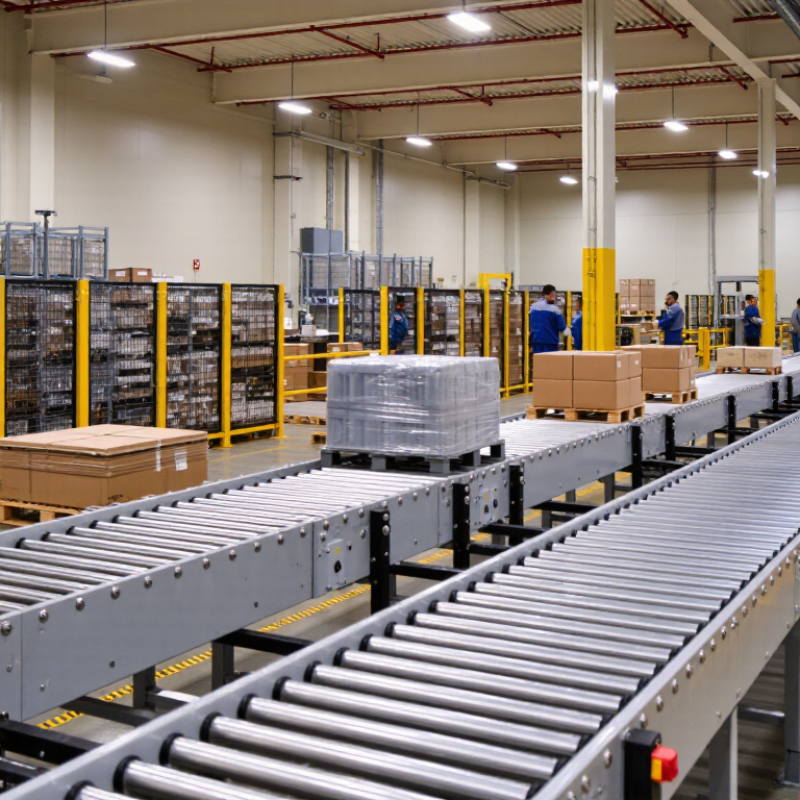
A roller conveyor is a material-handling system made of parallel rollers fixed inside a supporting frame. Loads move across these rollers with less sliding friction. Some systems rely on gravity, while powered models use motors, belts, or chains to rotate the rollers. The operating principle is simple: rotating surfaces support the load and guide it along a planned route.
In practical installations, gravity conveyors work well for cartons, totes, and pallets moving between different heights. The frame must have enough slope to maintain movement without causing sudden acceleration. Powered roller conveyors suit longer routes, frequent transfers, and controlled spacing. Sensors can stop a package at a work area, while side guides help prevent shifting. Small details matter. A poorly aligned roller can create noise, drag, or repeated package damage.
For global material handling, roller conveyors offer flexible layouts and relatively straightforward maintenance. Engineers can combine straight sections, curves, transfers, and accumulation zones for warehouses, factories, and distribution centers. Load weight, package shape, temperature, dust, and available floor space must guide the design. A light carton may move easily, but a soft or uneven package can behave differently. No conveyor is perfect. In real projects, early calculations sometimes miss seasonal volume or operator habits. Testing representative loads before installation can reveal these weaknesses and support safer, more reliable operation.
Which Materials and Industries Are Best Suited to Roller Conveyors?
Why Choose a Roller Conveyor for Global Material Handling?
Roller conveyors suit materials with firm, flat bases. Cartons, totes, pallets, trays, and sealed drums move smoothly across their rollers. They work well with uniform loads and predictable travel paths. Uneven bags can shift or stall. That limitation matters.
Warehouses, distribution centers, and manufacturing plants commonly use roller conveyors. Parcel operations benefit from quick carton movement and simple accumulation zones. Automotive facilities often transport parts in reusable bins. Food processors may use stainless steel designs with washable components. However, ordinary rollers are not always suitable for direct food contact. Hygiene, temperature, moisture, and cleaning requirements must guide the selection. In practical facility assessments, load weight and base condition often matter more than conveyor length. A visually efficient layout can still create jams.
Tips: Check the smallest load first. Measure its base, weight, and stability. Leave safe access for inspection and cleaning. Choose powered rollers when slopes cannot provide reliable movement. Include guards and emergency controls after a documented risk assessment. Test real products before committing to a full installation. Small trials reveal problems that drawings often miss.
How Do Roller Conveyors Improve Global Material Handling?
Roller conveyors improve global material handling by creating predictable paths for cartons, totes, and pallets. That consistency matters when goods cross ports, climates, and operating practices. Powered rollers maintain flow across longer distances. Gravity sections support controlled movement near packing stations. Operators spend less time carrying loads and more time checking labels, damage, and destination accuracy.
The 2024 MHI Annual Industry Report found that 91% of respondents expect supply chains to become more resilient within five years. Roller systems support this need by adding scalable capacity without redesigning every aisle. Correctly spaced rollers can reduce manual touches and keep cartons aligned for scanning. Sensors, accumulation zones, and variable-speed drives help prevent collisions at busy transfer points. The International Federation of Robotics recorded 541,302 industrial robot installations worldwide in 2023. Conveyors increasingly operate beside automated systems, not separately.
The improvement depends on practical design. A roller conveyor can amplify poor planning. Mixed carton sizes, dust, humidity, or weak guarding may create jams and unsafe workarounds. Site trials should test load weight, barcode placement, noise, emergency stops, and local maintenance skills. Global deployment also requires compatible electrical specifications and documented training. Recovery matters. If one zone stops, can workers bypass it safely? That question deserves more attention than a glossy throughput promise.
Why Choose a Roller Conveyor for Global Material Handling? - How Do Roller Conveyors Improve Global Material Handling?
| Performance Dimension | Typical Planning Data | Operational Benefit | Best-Fit Applications | Key Design Consideration |
|---|---|---|---|---|
| Unit Load Capacity | Approximately 5–2,000 kg per load, depending on roller diameter, pitch, frame design, and drive configuration | Supports products ranging from small cartons to pallets and heavy containers without requiring a continuous belt surface | Parcel handling, warehouse storage, manufacturing lines, pallet movement, and distribution centers | The load should normally be supported by at least three rollers at all times; concentrated loads require additional structural analysis |
| Typical Conveying Speed | Approximately 0.1–2.0 m/s for common carton and pallet applications | Allows systems to balance throughput, product stability, operator safety, and transfer accuracy | Order fulfillment, sortation, packaging, assembly, and shipping operations | Higher speeds require suitable guarding, controlled accumulation, accurate spacing, and compatible product packaging |
| Potential Throughput | Often about 20–120 cartons per minute, depending on product length, spacing, speed, and transfer layout | Creates a predictable flow of goods between receiving, storage, picking, packing, and dispatch areas | Distribution hubs, e-commerce fulfillment, parcel processing, and cross-docking facilities | Throughput is calculated from conveyor speed and product pitch; merges, curves, transfers, and manual workstations can reduce the final rate |
| Roller Diameter and Pitch | Common roller diameters are approximately 38–89 mm; roller pitch is selected so the load rests on multiple rollers | Improves load stability and helps maintain smooth movement across straight sections, curves, and transfers | Cartons, totes, trays, drums, cases, and pallet loads | Small or irregular products generally require a smaller pitch; large or heavy loads may require larger rollers and closer structural spacing |
| Accumulation Capability | Gravity systems provide limited accumulation; powered zero-pressure systems can create separate accumulation zones | Buffers production and shipping processes, reducing product collisions and minimizing stoppages caused by downstream delays | Packaging lines, order consolidation, palletizing, inspection, and dispatch buffering | Zero-pressure accumulation requires zone controls, sensors, and suitable product dimensions to maintain separation |
| Energy Use | Gravity roller conveyors require no conveyor drive; powered roller systems use energy only when driven, with zoned designs reducing idle operation | Can lower operating energy demand compared with continuously driven conveying equipment in appropriate layouts | Facilities with gravity flow, intermittent transport, accumulation, and mixed manual-automated operations | Actual energy consumption depends on load weight, speed, conveyor length, motor efficiency, duty cycle, and control strategy |
| Layout Flexibility | Available in straight sections, curves, merges, transfers, flexible sections, and multi-level configurations | Adapts material flow to different building layouts, process stages, and international facility standards | Warehouses, factories, airports, parcel centers, ports, and regional distribution facilities | Allow space for access, guarding, maintenance, emergency stops, fire protection, and safe operator movement |
| Integration with Automation | Can interface with photoelectric sensors, barcode or RFID identification, sorters, robotic cells, lifts, and warehouse control systems | Improves tracking, routing, accumulation control, and coordination between handling stages | Automated storage and retrieval, goods-to-person systems, robotic picking, and parcel sortation | Successful integration depends on control protocols, sensor placement, data quality, product identification, and local electrical requirements |
| Maintenance Profile | Routine checks typically include roller bearings, drive belts or chains, sensors, fasteners, guards, and alignment | Modular components make inspection and replacement more targeted, helping reduce extended line shutdowns | Continuous-use warehouses, manufacturing plants, distribution centers, and international logistics facilities | Inspection frequency should be based on operating hours, dust, moisture, temperature, load conditions, and manufacturer-maintained procedures |
| Global Deployment Suitability | Mechanical layouts can be standardized while electrical controls, safety devices, and documentation are adapted to local requirements | Supports repeatable system design across regions while accommodating different facility conditions and regulatory expectations | Multi-site logistics networks, international manufacturing, regional distribution, and global fulfillment operations | Projects should verify local machine safety, electrical, fire, seismic, guarding, noise, and accessibility requirements before installation |
| Product Compatibility | Works best with rigid-bottom cartons, totes, trays, cases, drums, and palletized loads | Provides low-friction transport with fewer belt-contact limitations for firm, stable loads | Consumer goods, packaged food, spare parts, appliances, industrial components, and general merchandise | Soft bags, unstable loads, very small items, and products with uneven bases may require carriers, side guides, belting, or an alternative conveyor type |
Note: The figures shown are general engineering planning ranges rather than guaranteed performance values. Final capacity, speed, throughput, energy use, and safety requirements should be confirmed through a site-specific conveyor design.
What Factors Should Guide Roller Conveyor Selection?
Why Choose a Roller Conveyor for Global Material Handling?
Selecting a roller conveyor starts with the load, not the catalog. Measure package length, width, weight, and bottom surface carefully. Uneven cartons may need closer roller spacing. Small items can drop between rollers. That detail is easy to miss.
Consider the required speed and movement pattern. Gravity rollers suit controlled zones and light-to-medium loads. Powered rollers provide steadier movement across longer routes. Accumulation systems reduce product contact and protect fragile packages. However, accumulation needs reliable sensors and clear control logic. Ask how workers will access the line during daily operations.
The working environment matters just as much. Dust, moisture, temperature changes, and washdown routines influence frame and bearing choices. Stainless or coated components may improve durability in demanding areas. Check electrical requirements and guarding against applicable local standards. Maintenance access should be practical, not merely listed on a drawing. Technicians need room to inspect bearings, remove debris, and replace parts safely.
I have seen layouts fail because operators were not consulted. A technically correct conveyor can still create awkward lifting or waiting points. The first design is rarely perfect. Test a representative load before ordering a full system. Observe noise, alignment, stopping distance, and transfer quality. Also review spare-part availability across regions. A low purchase price may become expensive when one small component causes extended downtime.
How Can Roller Conveyors Be Integrated and Maintained Worldwide?
Roller conveyors integrate well across warehouses, factories, ports, and distribution centers. Their modular frames allow local teams to extend lines, add transfers, or replace sections without rebuilding the entire route. Global projects still need shared interface standards. Frame widths, roller diameters, sensor signals, guarding, and emergency stops should be documented in one controlled specification.
Remote monitoring improves maintenance, especially when sites span several time zones. Temperature sensors can identify bearing friction, while vibration readings reveal misalignment. The U.S. Department of Energy’s Operations and Maintenance Best Practices Guide reports that predictive maintenance can reduce maintenance costs by 25–30% and downtime by 35–45%. Those figures are encouraging, but they depend on clean data and trained technicians. A sensor cannot repair a seized bearing.
Maintenance plans should match local conditions. Dust, humidity, temperature changes, and uneven floors affect roller performance. Weekly visual checks can catch belt drift, loose fasteners, and damaged guards. Monthly inspections should review bearings, shafts, drive chains, and emergency devices. MHI’s 2024 Annual Industry Report surveyed more than 2,200 supply-chain professionals, while 55% reported difficulty finding qualified workers. That shortage makes clear manuals, multilingual labels, and remote training practical investments. Yet relying only on remote support is risky. A local response team still needs spare rollers, basic tools, and authority to stop unsafe equipment.